

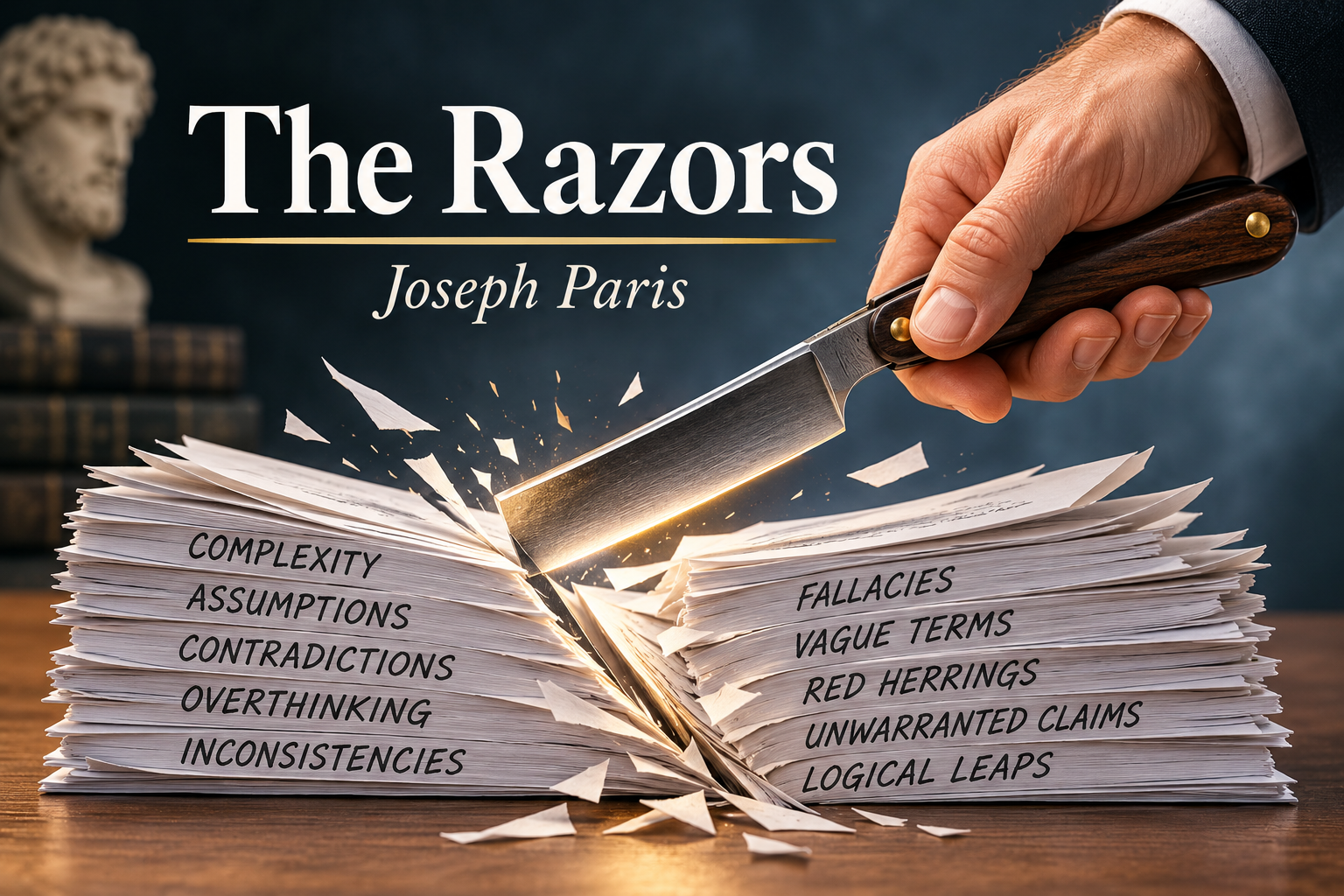
THE RAZORS; Eleven Rules That Separate Leaders From Everyone Else Wearing the Title

Why the same mental habits that make a great continuous-improvement practitioner also make a great leader; and how to build them on purpose.
The Problem
There is a saying I often use: you cannot fix what you refuse to see clearly. Most leadership failure – and most failed improvement efforts – isn’t a failure of intelligence. It’s a failure of thinking discipline. Smart people jump to the wrong conclusion faster than anyone, because smart people are good at building a convincing story around a bad assumption.

I have sat across the table from a lot of leaders and a lot of people carrying “improvement” in their job title, and here is the uncomfortable overlap: both jobs live or die on the same skill. Not a technical skill. Not the org chart, not the software, not the methodology on the wall poster. The skill is this: can you tell the difference between what you actually know and what you’ve simply decided to believe? And can you understand the person standing in front of you well enough to know which one they’re doing?
ParisJF: I once had a client swear their biggest quality problem was a vendor cutting corners on raw material; three weeks of escalations, a strained supplier relationship, and a procurement team treated like suspects. The real answer was a calibration drift on one line that nobody had checked in eight months. Three weeks of political cost to find a half-day fix, because the first assumption felt more satisfying than the boring one.
That gap, between what’s true and what’s convenient, is where organizations bleed time. Time is the enemy of the 21st century organization. Not cost. Not quality. Time. Every week spent debating a hypothesis that could have been dismissed in an afternoon is a week your competitor spent shipping. Every leader who assumes sabotage where there was only a missed email spends political capital they’ll need later, on a fight that was never real.
Here’s what nobody tells you when you’re coming up through the ranks, whether you’re aiming for a corner office or a career built on making things better: the tools and templates teach you what to measure. They do not teach you how to think, and they definitely don’t teach you how to read people. How you think, and how well you understand the human being across the table, is the actual differentiator; because anyone who stays in the work long enough learns the same tools. What isn’t the same is whether you can walk into a chaotic, emotionally loaded situation and cut through the noise without needing six weeks and a steering committee to do it.
That’s what razors are for. In philosophy, a razor is a rule that shaves away the unnecessary; the extra assumption, the unfounded claim, the debate that was never going to be resolved by more debate. I’ve collected eleven of them here. Eight are centuries old. Three – the Duck Test, Feynman’s Razor, and Alder’s Razor – are newer, more informal, and just as sharp. Understand all eleven, actually use them, not just nod at them in a training deck, and you are most of the way to being both a leader people trust and a continuous-improvement practitioner who gets real, lasting results instead of a laminated poster nobody looks at after month three.
Because here is the thing nobody puts on the wall chart: someone who can build a process map but can’t tell the difference between malice and carelessness when they’re standing on the floor is going to burn relationships they need for the next project. And a leader who can read a P&L but can’t separate what people actually said from what they were accused of saying is going to lose the room. Continuous improvement isn’t a toolkit. At its core, it’s critical thinking paired with empathy; the discipline to test what you’re told, and the humanity to understand why someone told it to you that way. Understanding these razors is understanding people. And understanding people is the actual heart of the work.

The Approach
I’ve grouped these eleven razors into four functions, because that’s how you’ll actually use them; not as a philosophy lecture, but as a sequence you run every time you’re facing a problem, a person, or a claim you’re tempted to just accept.
Group 1 — Finding the Real Problem
Occam’s Razor · Hanlon’s Razor · The Duck Test
Occam’s Razor says the explanation with the fewest assumptions usually wins. When you’re chasing why something went wrong, this is the razor that keeps you from building an elaborate theory involving three departments and a conspiracy when the real answer is that a spec sheet was never updated. You should consider it a personal failure every time your explanation has more moving parts than the problem it’s explaining.
Hanlon’s Razor is the one I lean on hardest as a leader: never attribute to malice what carelessness or incompetence already explains. In thirty years of walking factory floors and boardrooms, I can tell you that the vast majority of “them versus us” internal conflict isn’t sabotage. It’s someone who was never told, never trained, or never had the bandwidth to care. Leaders who assume malice build enemies out of people who were simply overwhelmed.
The Duck Test closes the loop: if it looks like a duck, swims like a duck, and quacks like a duck; stop overthinking it, it’s a duck. Not every problem needs a deep, drawn-out investigation. Sometimes the obvious answer, the one staring at you from the floor, is also the correct one. The discipline is knowing when you’re at that point and having the courage to stop analyzing and start fixing.
ParisJF: A plant manager once brought me in convinced his second shift was deliberately sandbagging output to protect overtime pay; a theory with its own spreadsheet and timeline. Twenty minutes on the floor and it was obvious: the handoff checklist from first shift was missing a step, so second shift spent the first forty minutes of every shift re-verifying work that should have already been verified. No conspiracy. No overtime scheme. Just a missing line on a checklist that had never been updated since the line was reconfigured. Fixed in a day; the sandbagging theory had been live for two months.
Group 2 — Testing What You’re Told
Hitchens’ Razor · The Sagan Standard · Popper’s Falsifiability · Alder’s Razor
Every stalled improvement initiative has, at its core, a claim nobody tested. This group gives you the tools to test it.
Hitchens’ Razor: what’s asserted without evidence can be dismissed without evidence. This is your shield against the loudest voice in the room becoming the accepted explanation by default. Someone says “it’s always been the supplier’s fault”. Fine, show me the data. Until then, that’s an opinion wearing a fact’s clothing.
The Sagan Standard raises the bar proportionally: extraordinary claims require extraordinary evidence. If someone tells you a change will double output, you don’t need to disprove it; you need them to bring proof that matches the size of the claim. The bigger the promise, the bigger the receipts required.
Popper’s Falsifiability Criterion is the one most improvement efforts skip past in the planning meeting and then violate constantly in practice. A theory that can never be proven wrong isn’t a theory; it’s a belief. If your improvement idea is structured so that any outcome, good or bad, can be explained away as proof you were right, you don’t have a project. You have a religion with a project charter. Let that land.
Alder’s Razor, also called Newton’s Flaming Laser Sword, is the practical cousin: if a disagreement can’t be settled by experiment or observation, arguing about it further is a waste of everyone’s time. This is where I tell teams to stop debating in the conference room and go find out. Reality will settle the argument faster than the meeting will.
Group 3 — Understanding the Person in Front of You
Grice’s Razor · Hume’s Guillotine
This is the group that gets skipped in almost every improvement training I have ever seen, and it’s the group that actually separates the leaders from the technicians. This is where critical thinking has to make room for empathy, or it turns cold and starts costing you the trust you need to get anything done.
Grice’s Razor, the Principle of Charity, says interpret people by what they meant, not by the most damning possible reading of their exact words. Someone on the floor who says “nobody cares about this line” is not filing a formal grievance you should parse for legal exposure. They’re telling you they feel invisible. Respond to the meaning, not the transcript, and you’ll get the truth instead of a guarded, defensive version of it.
Hume’s Guillotine, the Is-Ought Problem (I’m treating it as a razor, though Hume framed it as an epistemological distinction; the practical cut is the same), is the one that keeps leaders honest about their own bias. You cannot get from “here’s how things currently work” to “here’s how they should work” without smuggling in a value judgment. Every improvement recommendation carries an implicit “and this is better because…” Say that part out loud. Don’t hide your values inside what you’re presenting as pure data, because your team will smell the difference even when they can’t name it.
ParisJF: In the middle of a separation engagement – splitting a shared operation into two standalone entities on a hard deadline – a site leader kept telling me “we’ll figure out the transition plan as we go.” Taken literally, that’s an operational red flag: no plan, no readiness. Taken as what he meant, it was something else entirely; he didn’t trust the plan on paper because he’d been burned by a prior reorg where the plan looked perfect and fell apart on day one. Once I addressed that instead of the literal words, the conversation moved from defending a document to rebuilding his confidence in the process itself, which is what actually got the transition executed on schedule.
Group 4 — Making It Land
Einstein’s Razor · Feynman’s Razor
Einstein’s Razor: make everything as simple as possible, but no simpler. This is the discipline that stops a plan from becoming a forty-tab spreadsheet nobody will ever open. Simplicity isn’t the enemy of rigor. Over-engineering your explanation is usually a sign you didn’t fully understand the problem yourself.
Feynman’s Razor (what I call Feynman’s Razor. The name isn’t formal, but the principle is) is the final gate: if you can’t explain it to a person in plain language, you don’t actually understand it yet. I have watched sharp, credentialed people present a chart to a room full of peers and get nods, then fail completely to explain the same finding to the people who actually do the work. That gap isn’t a communication problem. It’s proof the thinking was never fully finished in the first place.
The Results
Here’s what changes when you actually run these eleven razors as habits instead of admiring them in a training deck.
Explanations get shorter and more accurate, because you stop entertaining theories that fail Occam’s test before you’ve even opened a notebook. Internal conflict drops, because Hanlon’s Razor keeps you from turning a missed handoff into a political war. Initiatives stop stalling in committee, because Alder’s Razor and Popper’s Falsifiability force you toward a testable claim instead of an endless argument nobody can win because nobody defined what winning would even look like.
Time – what I continue to preach is the enemy of the 21st century organization – comes back. Weeks that used to disappear into debates no one could win are spent shipping instead.
And the trust, the actual currency every leader is short on, trust builds faster, because Grice’s Razor and Hume’s Guillotine mean people feel heard accurately instead of parsed defensively, and they can see your recommendations for what they are: a judgment you’re standing behind, not a “fact” you’re hiding behind.
This is the part most improvement programs never quite say out loud: the technical side – the charts, the templates, the methodology – is trainable in weeks. Anyone reasonably capable can learn to build one. What can’t be taught from a slide deck, and what these eleven razors actually build, is judgment: the critical thinking to test what you’re told, and the empathy to understand why someone told it to you that way. Judgment, exercised consistently under pressure, is the entire definition of leadership; and it’s the actual engine behind continuous improvement, whatever methodology gets stapled on top of it. It is also, not coincidentally, the foundation of the 3Rs: the Robustness to hold up under pressure, the Readiness to act when the moment arrives, and the Resiliency to recover when things go sideways. Sharpen your thinking with these razors, and all three improve together.
ParisJF: On one multi-year transformation engagement, the team spent the first several months chasing assumption-driven fixes – new software, restructured reporting lines, a new KPI dashboard – because that’s what the steering committee was comfortable approving. None of it moved the number that mattered. The shift came when we stopped assuming and started testing: ran the actual bottleneck through Alder’s Razor (go find out, don’t argue about it), and ran the floor’s stated frustrations through Grice’s Razor instead of dismissing them as excuses. The real constraint turned out to be a single approval step two levels removed from where anyone was looking. Once that was fixed, the gains held; eighteen months later, no backslide, because the fix addressed what was actually true rather than what was politically easy to approve.
That’s the actual promise of Operational Excellence, and it’s the same promise embedded in these eleven old rules: readiness isn’t about having every answer. It’s about having a disciplined way to cut through the noise fast enough that you’re acting while everyone else is still arguing; and enough empathy to bring people with you when you do.
General George Patton put it more bluntly than I ever could: “A good plan violently executed now is better than a perfect plan executed next week.” The razors don’t hand you the perfect plan. They hand you the discipline to stop wasting time chasing one, and start executing on the plan that’s actually good enough to be right.
As Teddy Roosevelt said, “Do what you can, with what you got, from where you are.” Just make sure you’ve cut away the noise, and understood the people, first.
About the Author

Paris is an international expert in the field of Operational Excellence, organizational design, strategy design and deployment, and helping companies become high-performance organizations. His vehicles for change include being the Founder of; the XONITEK Group of Companies; the Operational Excellence Society; and the Readiness Institute.
He is a sought-after speaker and lecturer and his book, “State of Readiness” has been endorsed by senior leaders at some of the most respected companies in the world.
Click here to learn more about Joseph Paris or connect with him on Linkedin.