


Why ERP Readiness Must Come Before AI, Automation, and Digital Transformation

Article focus: ERP failure rarely starts in the system itself. It usually starts much earlier – in weak process clarity, poor data discipline, unclear ownership, fragmented governance, and underestimating the people side of change.

The Personal Trigger
I have lost count of how many times I have walked into an organization that believed the next system would finally solve everything.
Sometimes it was an ERP implementation. Sometimes it was a workflow platform. More recently, it has been AI. The language changes, the technology evolves, the budgets get bigger, but the pattern remains surprisingly familiar. Leaders are frustrated, teams are overwhelmed, and the business is carrying the invisible weight of broken flow, disconnected functions, poor data, and unclear ownership.
I remember one engagement where the ERP had become the villain in every meeting. Finance felt it was too rigid. Operations said it slowed them down. Procurement said it did not reflect reality. Users had built workarounds in spreadsheets, messages, and side conversations. Everyone agreed the technology was failing them.
Then we started walking the process – not the PowerPoint version, not the polished process map on the wall, but the real process. We followed the actual handoffs, the delays, the exceptions, the rework, the missing decisions, and the confusion between functions. What we discovered was uncomfortable but important: the ERP had not created the chaos. It had exposed it.
That moment has repeated itself in different forms throughout my work. It is one of the reasons I remain deeply passionate about process excellence. Operational excellence asks us to look beyond the easy explanation. It pushes us to stop blaming the tool and start understanding the operating model. It reminds us that technology does not create excellence. It amplifies whatever already exists – whether that is clarity or confusion.
Why This Matters Beyond the Project Team
For many senior leaders, ERP readiness sounds like a technical topic. It is not. It is a business performance topic. When readiness is weak, the consequences show up far beyond the implementation team. They appear in delayed decisions, inconsistent service, poor forecasting, weak inventory control, unreliable reporting, low user adoption, and endless firefighting.
Organizations pay for weak readiness twice. First, they pay for the operational inefficiency that already exists. Then they pay again when they try to digitize that inefficiency through ERP, automation, analytics, or AI. Instead of gaining control, they often create faster confusion.
This is why ERP readiness should be viewed as a strategic capability. AI needs structured workflows, reliable data, and clear decision logic. Automation needs repeatable and stable processes. ERP needs aligned processes, disciplined master data, defined roles, and governance. Without these foundations, companies do not get transformation. They get digitized dysfunction.
Operational excellence by design is what turns investment into outcome. It is the bridge between ambition and execution. It gives organizations the discipline to scale, to absorb change, to use technology well, and to improve the circumstances of the people doing the work.
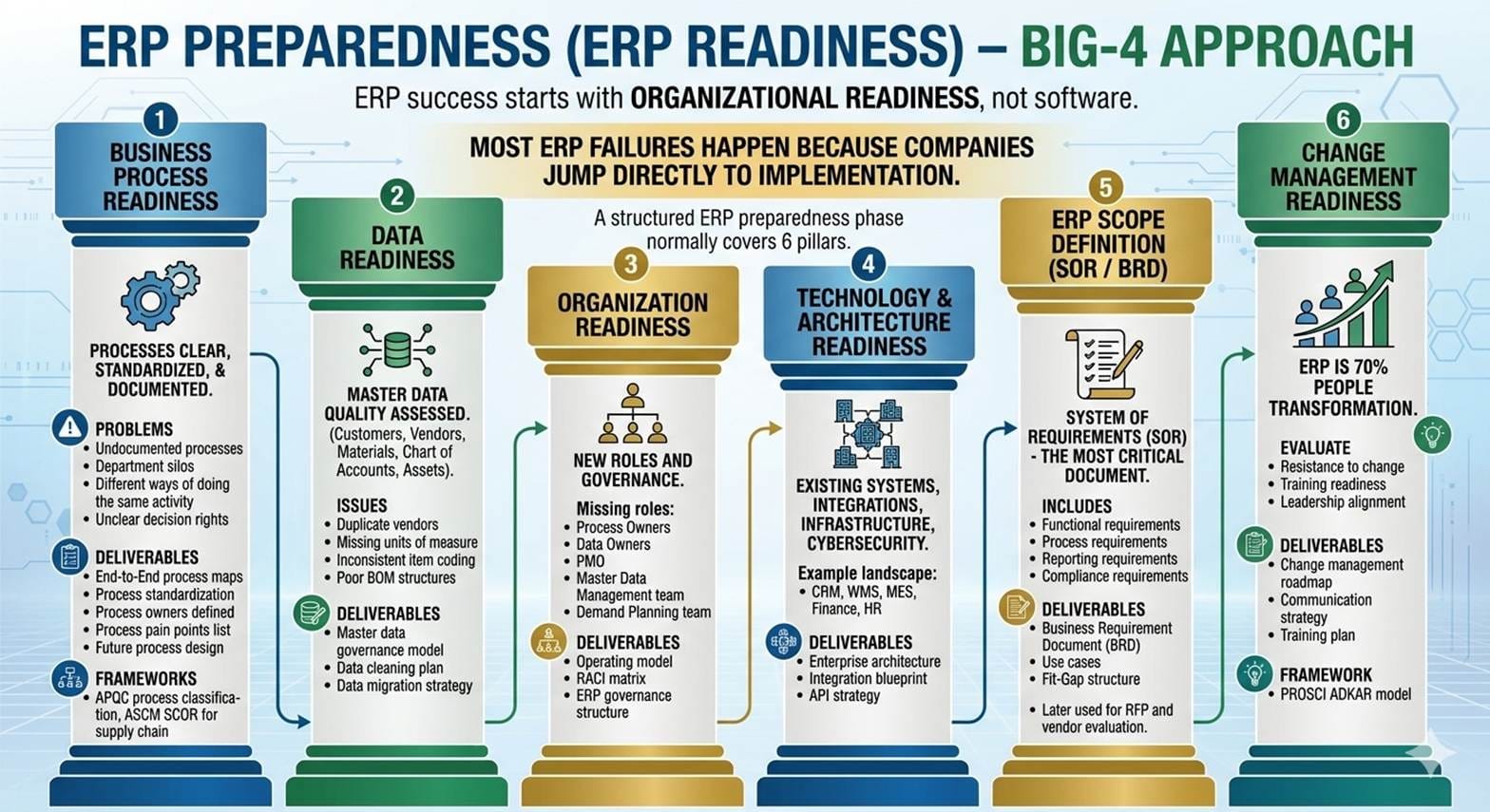
How to Build ERP Readiness in Practice
The starting point is a shift in mindset. Companies must accept that fixing performance is not the same as buying capability. Capability has to be designed into the way the business works. That means moving beyond silo optimization and focusing on end-to-end value flow.
The next step is to understand the work as it truly happens. This requires gemba-style observation, listening to the people doing the work, and identifying where the operating reality diverges from the intended process. In nearly every transformation effort, that is where the truth reveals itself. Approvals are unclear. Decision rights are blurred. Data ownership is weak. Exceptions are unmanaged. Metrics encourage the wrong behaviors. Teams compensate with personal effort and institutional memory.
From there, the organization must define and prioritize the key end-to-end processes that most affect performance, customer outcomes, cost, speed, and strategic delivery. The goal is not only to map activities. It is to define ownership, interfaces, business rules, controls, information needs, and escalation points.
A structured readiness approach typically covers six connected pillars: business process readiness, data readiness, organization readiness, technology and architecture readiness, ERP scope definition, and change management readiness. These are not separate checklists. They are interdependent conditions for success.
Methodology matters. Good frameworks are helpful, but they are not enough on their own. Organizations need a practical approach that combines diagnostics, governance clarity, role definition, data discipline, design decisions, KPI alignment, and adoption planning. One of the biggest perils in transformation is mistaking activity for progress. Workshops can be full, slides can look polished, and steering committees can meet regularly, yet nothing really changes if the underlying operating logic remains weak.
Another common peril is letting technology design run ahead of business design. The system team starts configuring while the business is still debating how the process should work. Different departments operate with different assumptions. Nobody fully owns the cross-functional model. Months later, the organization discovers it has encoded confusion into the system. That is not a software problem. That is a readiness problem.
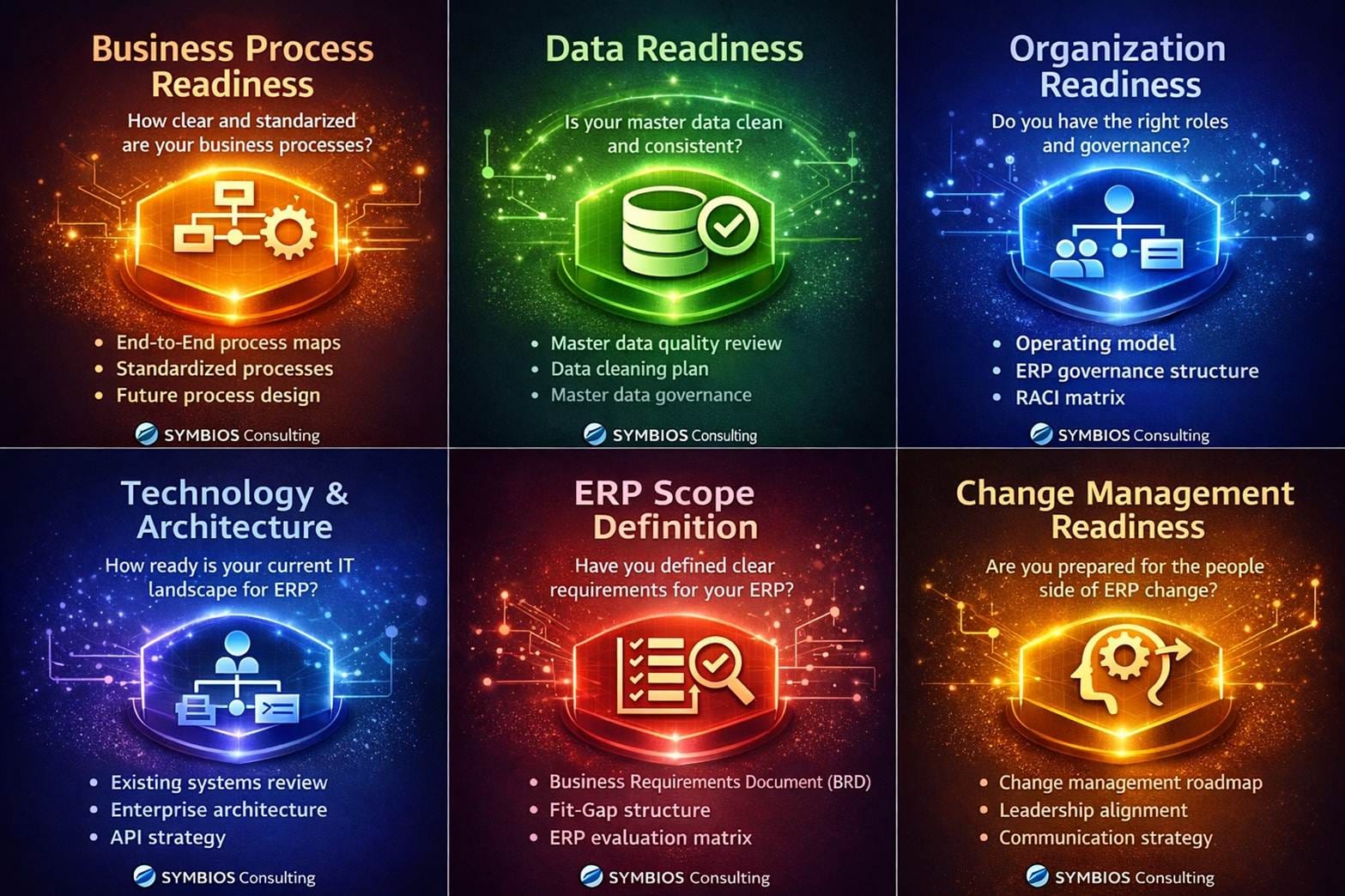
What Is Actually Required
Time is required – not endless time, but protected time from the right people. ERP readiness cannot be delegated only to project teams or external advisors. Business leaders must engage because process decisions are management decisions.
Talent is required. Organizations need strategic leadership, operational knowledge, process capability, change leadership, and business-technology translation. The people who understand the work must be involved. The people who can redesign it must be empowered. And the people who will live with the outcome must believe in it.
Discipline in data and governance is required. A company does not need perfect data before improvement begins, but it does need accountability for data ownership, key definitions, master data integrity, and decision rights. Many execution issues are actually governance issues wearing an execution disguise.
Budget is required, but not only for software or consultants. The less glamorous foundations often determine the success of the investment: process work, capability building, testing, training, role clarity, leadership alignment, and adoption support.
The right organizational conditions are also essential. These include executive sponsorship, honest diagnostics, cross-functional collaboration, tolerance for inconvenient facts, and willingness to simplify. Complexity is often defended as if it were sophistication. In reality, it is often accumulated ambiguity.
Conclusion: Readiness Is the Real Advantage
When these conditions are present, something powerful happens. The organization begins to shift from dependency on individuals to dependency on design. Problems become easier to see. Decisions become easier to make. Teams spend less time chasing information and more time creating value. Technology starts to support the business instead of fighting it.
ERP becomes more useful. AI becomes more meaningful. Improvement becomes repeatable instead of heroic. And perhaps most importantly, people feel the difference. Expectations become clearer. Friction is reduced. Rework declines. Accountability becomes fairer because the system around the people is better designed.
That is the real promise of operational excellence by design. If a company follows this approach, it should expect more than cleaner processes. It should expect stronger business performance, better adoption of technology, more reliable execution, improved visibility, and a healthier operating rhythm.
In a world rushing toward AI, automation, and constant digital change, readiness may be one of the most strategic advantages a company can build. Not readiness as a slogan, but readiness as a way of operating. Readiness that comes from process clarity, disciplined design, aligned leadership, and commitment to making the business truly work.
That is why I keep returning to process excellence. Not because it is fashionable, and not because it fits neatly into a transformation program, but because it remains one of the most powerful ways to improve company performance and the circumstances of those who work there.
Technology alone is not enough. Excellence is the driver.
Note: The article uses the two strongest ERP readiness visuals for clarity and consistency – the full six-pillar framework and the pillar-level readiness view.
About the Author

Shereen Mosallam is the general manager of Symbios Consulting. She is a transformation advisor and business leader with deep experience in operational excellence, process excellence, supply chain transformation, ERP readiness, digital transformation, and AI-enabled improvement across multiple industries. She is passionate about helping organizations improve performance by aligning people, processes, governance, data, and technology to create sustainable and measurable results.


