

Embrace the Suck: The Navy SEAL Way to an Extraordinary Life


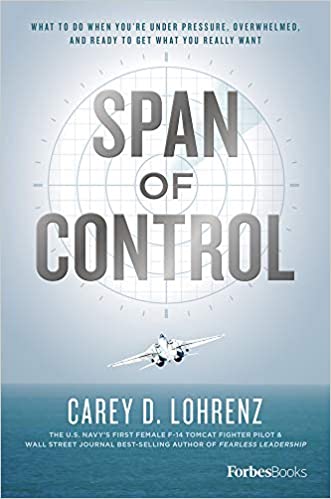
Span Of Control
What can you control?
What do you do when you’re under pressure, overwhelmed, and ready to get what you really want? As one of the first female F-14 Tomcat fighter pilots in the US Navy, as well as a mom, wife, business consultant, Wall Street Journal bestselling author, and global speaker, author Carey Lohrenz knows that the stress we experience can be just as intense as the stress in the cockpit of a fighter jet going Mach 2. But she’s got a secret weapon to prevail: years of training to overcome the specific natures of uncertainty, stress, burnout, anxiety, and pressure.
At our core, we know we’ve lost control. We’ve lost our grip on what we really want and who we really want to be. In order to solve the challenges of chaos and make our goals, dreams, and commitments a reality, we have to understand that in order to succeed when the pressure is on and to improve our performance overall, we’ve got to know what we can and cannot control.
In Span of Control, Lohrenz walks us through the fundamentals of surviving and succeeding during times of crisis. Weaving together eye-opening science, gripping personal stories, insightful interviews, prescriptive advice, and a high-octane dose of encouragement and practicality, Span of Control helps leaders recognize how to focus on what matters most, formulate a plan for success, and communicate what’s possible.
More info →
Dream Teams: Working Together Without Falling Apart
Award-winning entrepreneur and journalist Shane Snow reveals the counterintuitive reasons why so many partnerships and groups break down--and why some break through.The best teams are more than the sum of their parts, but why does collaboration so often fail to fulfill this promise? In Dream Teams,...
More info →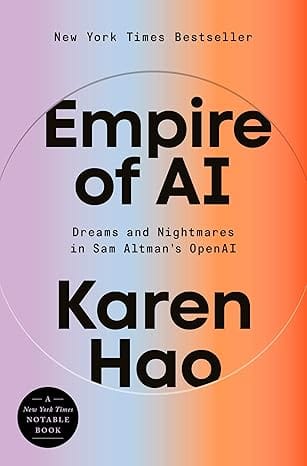
Empire of AI: Dreams and Nightmares in Sam Altman’s OpenAI
A New York Times Notable Book • Winner of the National Book Critics Circle Award for Nonfiction • A New York Times Bestseller • Named a Best Book of the Year by Smithsonian, Scientific American, and Elle • Winner of the Porchlight Business Book Award
“A bestselling page-turner that has made waves not just in Silicon Valley but around the world . . . With Empire of AI, Hao is fundamentally shaping many people’s perceptions and understanding of the company at the center of the AI revolution.” —TIME Magazine, “TIME100 AI 2025”
“Excellent and deeply reported.” —Tim Wu, The New York Times
“Startling and intensely researched . . . an essential account of how OpenAI and ChatGPT came to be and the catastrophic places they will likely take us.” —Vulture
From a brilliant longtime AI insider with intimate access to the world of Sam Altman's OpenAI from the beginning, an eye-opening account of arguably the most fateful tech arms race in history, reshaping the planet in real time, from the cockpit of the company that is driving the frenzy
When AI expert and investigative journalist Karen Hao first began covering OpenAI in 2019, she thought they were the good guys. Founded as a nonprofit with safety enshrined as its core mission, the organization was meant, its leader Sam Altman told us, to act as a check against more purely mercantile, and potentially dangerous, forces. What could go wrong?
Over time, Hao began to wrestle ever more deeply with that question. Increasingly, she realized that the core truth of this massively disruptive sector is that its vision of success requires an almost unprecedented amount of resources: the “compute” power of high-end chips and the processing capacity to create massive large language models, the sheer volume of data that needs to be amassed at scale, the humans “cleaning up” that data for sweatshop wages throughout the Global South, and a truly alarming spike in the usage of energy and water underlying it all. The truth is that we have entered a new and ominous age of empire: only a small handful of globally scaled companies can even enter the field of play. At the head of the pack with its ChatGPT breakthrough, how would OpenAI resist such temptations?
Spoiler alert: it didn’t. Armed with Microsoft’s billions, OpenAI is setting a breakneck pace, chased by a small group of the most valuable companies in human history—toward what end, not even they can define. All this time, Hao has maintained her deep sourcing within the company and the industry, and so she was in intimate contact with the story that shocked the entire tech industry—Altman’s sudden firing and triumphant return. The behind-the-scenes story of what happened, told here in full for the first time, is revelatory of who the people controlling this technology really are. But this isn’t just the story of a single company, however fascinating it is. The g forces pressing down on the people of OpenAI are deforming the judgment of everyone else too—as such forces do. Naked power finds the ideology to cloak itself; no one thinks they’re the bad guy. But in the meantime, as Hao shows through intrepid reporting on the ground around the world, the enormous wheels of extraction grind on. By drawing on the viewpoints of Silicon Valley engineers, Kenyan data laborers, and Chilean water activists, Hao presents the fullest picture of AI and its impact we’ve seen to date, alongside a trenchant analysis of where things are headed. An astonishing eyewitness view from both up in the command capsule of the new economy and down where the real suffering happens, Empire of AI pierces the veil of the industry defining our era.
More info →
Enfoque de sistemas: Teoría para Resolver Problemas de Inventiva (TRIZ) (Spanish Edition)
En este libro se describe un enfoque sistémico. Se abordan definiciones básicas como: pensamiento sistémico, teoría de sistemas, análisis y síntesis del sistema. El concepto de sistemas y sus componentes se analizan como una to-talidad integral, una propiedad y una posición, también como un sistema técni-co y antropogénico. Además, se caracterizan las funciones, procesos, flujos y jerarquías del sistema.
Se presenta el concepto de consistencia y requerimientos del sistema, mientras que el operador del sistema se describe tomando en cuenta cualquier cambio y sus efectos en el sistema.
Posteriormente el contenido se centra en el análisis y síntesis de sistemas, así como en el enfoque de sistemas para el diseño.
El análisis sistémico se usa para no dejar lagunas en la siguiente secuen-cia: análisis de componentes, análisis estructural, análisis funcional y análisis de diagnóstico.

Business Adventures: Twelve Classic Tales from the World of Wall Street
“Business Adventures remains the best business book I’ve ever read.” —Bill Gates, The Wall Street Journal What do the $350 million Ford Motor Company disaster known as the Edsel, the fast and incredible rise of Xerox, and the unbelievable scandals at General Electric and Texas Gulf Sulphur h...
More info →