

Is your organization slowing you down instead of speeding you up? The right organizational design aligns your structure, people, and processes with your strategy — eliminating bottlenecks, clarifying accountability, and unlocking performance at every level. Whether you’re scaling fast, navigating change, or simply leaving efficiency on the table, smart org design transforms how work actually gets done. Stop managing around your structure. Start building one that works for you.

Organization Design: Simplifying complex systems
A well-designed organization is an effective organization. Decisions about organization design determine the shape and form of the organization – not only the reporting structure and authority relations, but also the number and size of sub-units and the interfaces between the sub-units. Indirectly...
More info →


Knowledge Management and Organizational Design (Resources for the Knowledge-Based Economy)
The first in the readers' series called Resources for the Knowledge-Based Economy, Knowledge Management and Organizational Design is a unique compilation of articles and book excerpts that describe how the management of an organization shapes the levels of knowledge transfer, innovation and learning...
More info →
Agile IT Organization Design: For Digital Transformation and Continuous Delivery
To gain the full benefits of agility in any software organization, you need to extend it beyond developers to the organization as a whole. Aspiring digital businesses need overall agility, not just development team agility. Now, Sriram Narayan, IT management consultant at ThoughtWorks, shows how to ...
More info →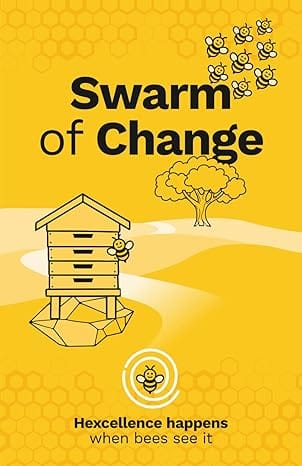
Swarm Of Change: Hexcellence Happens When Bees See It
Most improvement programmes fail for a simple reason.
People are told to change.
Swarm of Change shows what happens when people discover improvement for themselves.
When a struggling hive loses its leadership, the bees face rising pressure, confusion, and overwork.
The natural response would be tighter control and louder direction.
Instead, something unexpected happens.
A few bees begin asking better questions.
Slowly the hive starts to see problems differently.
Small changes appear.
Confidence grows.
Improvement begins to spread.
What unfolds is a story about how real change emerges, not through instruction or programmes, but through shared understanding and small actions taken together.
But Swarm of Change is more than a story.
Behind the narrative sits a practical activation model developed from more than 25 years working with organisations seeking to build real improvement capability.
The approach helps teams:
• See problems more clearly
• Turn ideas into small improvements
• Support others to learn and improve
• Build momentum that spreads across teams
Two simple lenses help organisations see this happening:
PRIME - participation in improvement. Who is reading, contributing, mentoring, and engaging.
PACE - improvement activity. Problems identified, actions taken, and effective changes.
Together they make improvement visible, and help organisations understand where change is growing.
Early readers from manufacturing, healthcare, leadership development, and education have recognised the value of the approach.
Former Toyota leaders, Lean authors, Shingo Institute faculty, and senior industry practitioners have all previewed the book and shared their reflections.