

Is your business bleeding time and money on inefficiencies you can’t even see yet? Lean Six Sigma gives you the tools to find them, fix them, and keep them fixed. By eliminating waste and crushing process variation, your teams move faster, your customers get better results, and your bottom line reflects it. This isn’t a one-time fix — it’s a culture of continuous improvement. The question isn’t whether you can afford Lean Six Sigma. It’s whether you can afford to ignore it.

Design for Operational Excellence: A Breakthrough Strategy for Business Growth
The ability to implement and maintain improvement initiatives like Lean and Six Sigma is essential for improving quality, eliminating waste, reducing costs, and increasing output―but it’s only the first step. Eventually, the improve-sustain-improve-sustain pattern itself becomes the end product. But it doesn’t have to be this way.
More info →


A Revolution in Manufacturing: The SMED System: Single-minute Exchange of Die System
Written by the industrial engineer who developed SMED (single-minute exchange of die) for Toyota, A Revolution in Manufacturing provides a full overview of this powerful just in time production tool. It offers the most complete and detailed instructions available anywhere for transforming a manufacturing environment in ways that will speed up production and make small lot inventories feasible. The author delves into both the theory and practice of the SMED system, explaining fundamentals as well as techniques for applying SMED. The critically acclaimed text is supported with hundreds of illustrations and photographs, as well as twelve chapter-length case studies.
More info →
Lean-Driven Innovation: Powering Product Development at The Goodyear Tire & Rubber Company
In 2005, Goodyear’s research and development (R&D) engine was not performing up to its full potential. The R&D organization developed high-quality tires, but the projects were not always successful. Goodyear embarked on a major initiative to transform its innovation creation processes by learning, understanding, and applying lean product development principles. Within five years, Goodyear saw its product development cycle times slashed by 70 percent, on-time delivery performance rise close to 100 percent, and throughput improve three-fold – all achieved with no increase in the R&D budget.
Lean-Driven Innovation: Powering Product Development at The Goodyear Tire & Rubber Company describes in great detail how the Goodyear team was able to achieve such significant improvements. Revealing the ups and downs of this successful transformation, the book shares experiences of how this seismic change was managed, how people were engaged, and how Goodyear dramatically reinvigorated its product development and innovation processes―and, in the process, delivered substantial more value to customers and to the company.
The book also explains how lean product development helped Goodyear dramatically improve revenue by having every new product available when the market needed it. Presenting wide-ranging perspectives from all levels of leadership, this book is ideal for anyone in R&D daring to take on a lean initiative in R&D or who is struggling with a lean transformation that is not delivering to its full potential. Since the book focuses on universal lean principles, it is as insightful to other manufacturing and nonmanufacturing disciplines in any industry as well.
The book presents invaluable insights gained by the author during his 36 years within Goodyear, of which 10 have been directly involved in trying to develop, implement, and sustain lean to achieve the company’s business objectives. It distills ideas, practices, failures, and successes into key principles that lean product development practitioners can easily implement.
After reading this book, you will gain a practical path for applying lean to the innovation processes of your organization, including where to begin and what to do, regardless of the industry and the status of your transformation.
Watch Norbert Majerus discuss Lean-Driven Innovation at: https://youtu.be/yIlJEMJIcyA
More info →
Why Lean Transformation Fails: Common challenges to adopting new leadership and management system
Failure is merely a temporary weakening of momentum on the way to sustained success. Learning from past Lean transformation failures will help any organization mitigate against the many challenges of changing culture, management systems, and leadership styles.
Why Lean Transformation Fails is a brief it contains summaries, antcidotes, and reproduced content from organizations such as Virginia Mason Medical Center; New United Motor Manufacturing, Inc; Saturn Corporation; General Motors; Toyota; Toyota's suppliers; the Saskatchewan health System; ThedaCare; and Wiremold.
With a Foreword from Bob Emiliani, PhD and Afterword from Martial Durin the Managing Director, Kaizen Institute China; contributor, editor, and author Steven Leuschel pulls together stories and lessons anyone implementing a lean journey can learn from to overcome barriers of Lean transformation.
More info →
Sensei Secrets: Mentoring at Toyota Georgetown
This study examines the developmental interactions between Japanese senseis (mentors) and early American leaders at Toyota Motor Manufacturing Kentucky (TMMK). More specifically, this study examines why and how these early American leaders transitioned from the initiation phase of a mentor relationship to the active and transforma- tional participation of the cultivation phase. This research identifies characteristics of developmental interactions so that other leaders and mentors can effectively adapt Toyo- ta-style management practices and thinking.
Though the professionalization of Toyota Production Systems (TPS), also known as lean manufacturing, or sim- ply lean, has proven to be vast, the success rate of emula- tion and adaptation of sustained TPS has been low. One of the many problems that organizations face when adapting TPS is executive resistance and misunderstanding of lean management and leadership (Emiliani, 2018; Sherman, 1994). Toyota faced a similar problem of resistance when it hired leaders from other automotive companies into Toyota during the initial years at TMMK. Understanding how Toy- ota overcame this resistance offers insight into better mento- ring for adapting TPS.
This study performs qualitative interviews using oral history and grounded theory techniques. It specifically identifies characteristics of the transition from the initiation to cultivation phases of mentor relationships within TMMK from 1986 to 1992. This research illustrates how leaders who never before experienced the Toyota culture experienced transformation within mentor relationships, which enabled them to adopt Toyota's frame of reference for solving prob-lems and ultimately Toyota's culture. The findings may prove adaptable and beneficial for other leaders and execu- tives adopting TPS.
More info →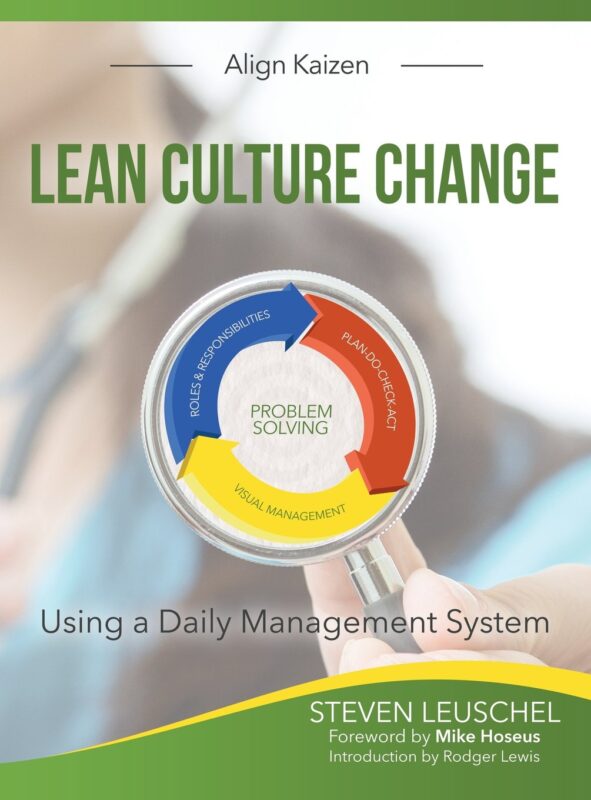
Lean Culture Change: Using a Daily Management System
Lean Culture Change, Reveals Phase 1 Level A of The Transformation Curve
Steven Leuschel, Lean healthcare practitioner pens book, Lean Culture Change Using a Daily Management System. This new book reveals decades of organizational transformation knowledge deeply rooted in the Toyota Production System and Toyota’s culture.
Lean Culture Change is based on the teachings of Rodger B. Lewis, former General Manager of Quality at Toyota during the Georgetown ramp up. Lewis via the Transformation Curve has successfully transformed divisions of General Motors and organizations around the globe for decades. Now, it’s time that healthcare organizations begin to learn a long-term strategic approach to transformation— not just becoming Lean, doing kaizen events, or creating a model cell. In Lean Culture Change, Leuschel describes the initial steps of the Transformation Curve’s Phase 1 Level A with real-life healthcare examples and case studies.
Lean Culture Change is designed to be a training manual for team leaders and Senior Leaders who wish to study and adapt the Transformation Curve. It contains over 200 pages, 100 images/examples, and 6 case studies, an Afterword and Post Script.
More info →