


The Pathway to Operational Excellence in the Pharmaceutical Industry
In order to face a new market reality, Operational Excellence initiatives will build the cornerstones of future operations strategies in the pharmaceutical sector. The biggest challenge is and will be the engagement of people. The authors of this book point out that it will be the ability to make each employee think in terms of continuous improvement and change that will enable companies to overcome the organizations internal inertia and separate the winners from the losers. Leading managers, consultants and researchers from both sides of the Atlantic contributed to this second book about a topic that has already started to change the way thousands of employees understand and do their jobs. As an addition to the first book Operational Excellence in the Pharmaceutical Industry which focused on the essence of OPEX, this book focuses on the managerial and organizational aspects of comprehensive Operational Excellence programs.
More info →

The Lean Startup: How Today’s Entrepreneurs Use Continuous Innovation to Create Radically Successful Businesses
Most startups fail. But many of those failures are preventable. The Lean Startup is a new approach being adopted across the globe, changing the way companies are built and new products are launched.
More info →

The Toyota Way to Continuous Improvement: Linking Strategy and Operational Excellence to Achieve Superior Performance
Building upon the international bestselling Toyota Way series of books by Jeffrey Liker, The Toyota Way to Continuous Improvement looks critically at lean deployments and identifies the root causes of why most of them fail. The book is organized into three major sections outlining:
1) Why it is critical to go beyond implementing lean tools and, instead, build a culture of continuous improvement that connects operational excellence to business strategy
2) Case studies from seven unique industries written from the perspective of the sensei (teacher) who led the lean transformation
3) Lessons about transforming your own vision of an ideal organization into reality

The Six Sigma Way: How to Maximize the Impact of Your Change and Improvement Efforts, Second edition
The Definitive Work on Six Sigma―Revised and Fully Updated
More info →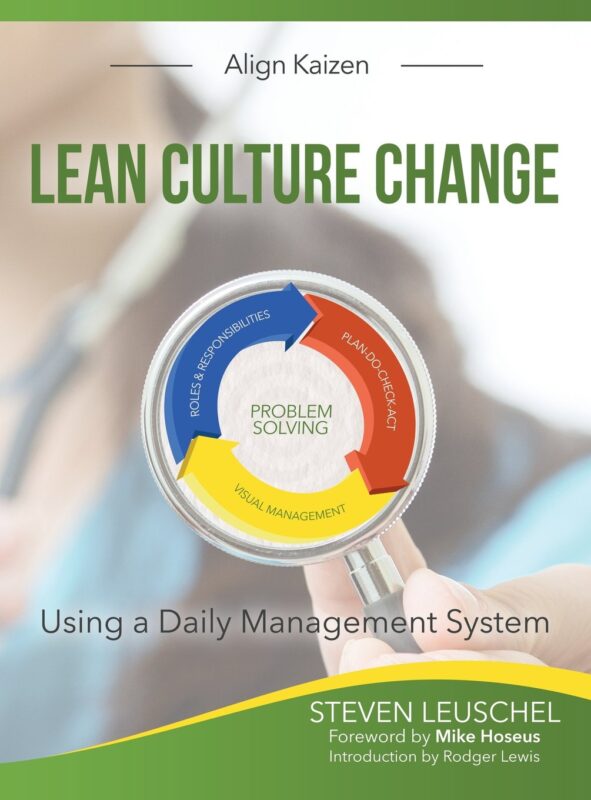
Lean Culture Change: Using a Daily Management System
Lean Culture Change, Reveals Phase 1 Level A of The Transformation Curve
Steven Leuschel, Lean healthcare practitioner pens book, Lean Culture Change Using a Daily Management System. This new book reveals decades of organizational transformation knowledge deeply rooted in the Toyota Production System and Toyota’s culture.
Lean Culture Change is based on the teachings of Rodger B. Lewis, former General Manager of Quality at Toyota during the Georgetown ramp up. Lewis via the Transformation Curve has successfully transformed divisions of General Motors and organizations around the globe for decades. Now, it’s time that healthcare organizations begin to learn a long-term strategic approach to transformation— not just becoming Lean, doing kaizen events, or creating a model cell. In Lean Culture Change, Leuschel describes the initial steps of the Transformation Curve’s Phase 1 Level A with real-life healthcare examples and case studies.
Lean Culture Change is designed to be a training manual for team leaders and Senior Leaders who wish to study and adapt the Transformation Curve. It contains over 200 pages, 100 images/examples, and 6 case studies, an Afterword and Post Script.
More info →
Why Lean Transformation Fails: Common challenges to adopting new leadership and management system
Failure is merely a temporary weakening of momentum on the way to sustained success. Learning from past Lean transformation failures will help any organization mitigate against the many challenges of changing culture, management systems, and leadership styles.
Why Lean Transformation Fails is a brief it contains summaries, antcidotes, and reproduced content from organizations such as Virginia Mason Medical Center; New United Motor Manufacturing, Inc; Saturn Corporation; General Motors; Toyota; Toyota's suppliers; the Saskatchewan health System; ThedaCare; and Wiremold.
With a Foreword from Bob Emiliani, PhD and Afterword from Martial Durin the Managing Director, Kaizen Institute China; contributor, editor, and author Steven Leuschel pulls together stories and lessons anyone implementing a lean journey can learn from to overcome barriers of Lean transformation.
More info →